George Town, One Hawker Table at a Time
Follow Penang’s shophouses, shared tables and living traditions through a food-focused stay that leaves room for the city itself.
Begin with the shape of the old town
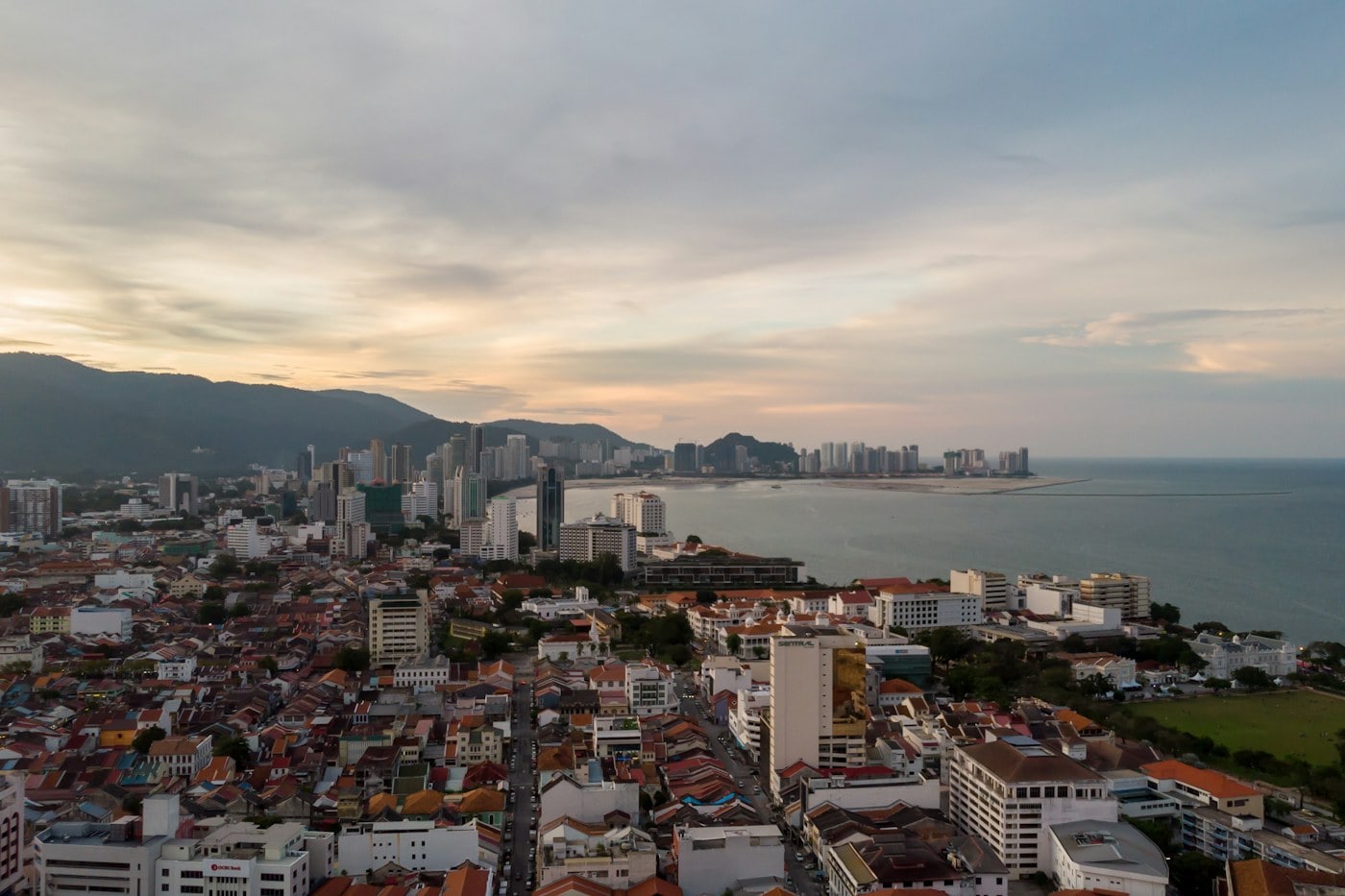
George Town rewards a map that has room around its landmarks. The historic center occupies the northeastern corner of Penang Island, with the waterfront on one side and streets of shophouses running inland. Start around Armenian Street, but do not make street art the entire purpose of the walk. Covered five-foot ways, courtyard houses and small workshops reveal the practical architecture behind the city’s familiar photographs. A lane can be a workplace, delivery route and social space at once.
The walk from Armenian Street toward Lebuh Acheh offers a useful introduction to how close different community institutions stand. The Acheen Street Mosque, clan buildings and Chinese temples belong to overlapping histories of settlement and trade. Continue toward Cannon Street for another change of scale, then turn into a side street rather than returning immediately to the busiest murals. The five-foot ways were designed as sheltered pedestrian space, although shop displays and steps can interrupt them. They are therefore helpful in sun or rain but cannot be assumed to form a completely level, unobstructed route. At street corners, look both ways for turning vehicles even where the walking atmosphere feels relaxed.
Order breakfast as a meal, not a checklist
Breakfast provides an easy introduction to the city’s layered food culture. Kopitiam tables may gather coffee, toast and dishes supplied by separate stalls. Look at how ordering works before taking a seat: drinks and food can come from different people. White coffee is associated more closely with Ipoh, so avoid assuming every Malaysian coffee follows the same preparation. In George Town, the interest lies in the individual shop, the toast station and the rhythm of regular customers.
The traditional kopitiam setup also explains why an apparently empty table may not mean unrestricted seating. A coffee shop may expect customers to order drinks while food comes from a tenant stall. Ask before settling in with something bought elsewhere. Kaya toast usually brings coconut-and-egg spread into the meal, while soft-boiled eggs require their own bowl and seasoning routine. If you prefer a fuller breakfast, look at what the noodle or rice stall actually serves that morning. A small shop with one well-practiced dish can be more satisfying than a menu covering the whole island. Order in stages, particularly when the coffee and food arrive independently.
Understand what a hawker center offers
A hawker center is useful precisely because companions can choose different dishes and still eat together. Char koay teow, Hokkien mee and curry mee are separate traditions rather than interchangeable bowls of spicy noodles. Ingredients vary, and apparently simple food can contain shellfish, pork or dried seafood. Ask clear questions when dietary restrictions matter. Watch a cook’s station from a respectful distance; the speed comes from practiced repetition, and a crowded counter is not a good place to demand a performance.
Penang Hokkien mee commonly centers on a prawn-based broth, distinct from dishes carrying the same name elsewhere in Malaysia. Char koay teow generally involves flat rice noodles cooked rapidly in a wok; the balance of seafood, egg and other ingredients belongs to the individual stall. Asam laksa brings another flavor family, with a sour fish-based broth rather than a rich coconut soup. These differences make a useful basis for two separate meals. Choose a broth dish one day and a wok dish another rather than lining up multiple full portions at one sitting. If you want vegetarian food, ask about stock, dried shrimp and cooking fat as well as visible toppings.
Let Little India be a neighborhood
Around Lebuh Queen and the streets nearby, shops, places of worship and food businesses form a lively part of the city’s everyday geography. The area should not be treated as a stage set that exists for visitors. A meal here might involve banana-leaf rice or a simple dosa, but menus differ and customs at each restaurant matter. Follow the staff’s guidance about service and clearing. Music, textiles and groceries tell another part of the story beyond the plate.
From the Queen Street area, the Kapitan Keling Mosque and nearby streets help place Little India within the broader heritage center. The walk is short enough to combine with lunch without adding a transport leg. Restaurant service may be counter-based or table-based, and a banana-leaf meal can involve staff returning with different components. Ask what the initial order includes rather than assuming every offered item is part of a fixed set. A dosa breakfast and a rice lunch offer different experiences, so choose according to appetite and time. When shops become busy, leave the covered passage clear; it serves pedestrians and customers moving between closely spaced businesses.
Read the waterfront carefully
The clan jetties are often presented as a single attraction, yet they include residential spaces with different degrees of visitor access. Chew Jetty is the best-known example, with timber walkways extending over the water. Stay on clearly public routes and notice signs that distinguish homes from businesses. The view across the water helps explain George Town’s trading history, but the people living beside that view deserve privacy. Sunrise and evening have different atmospheres; neither justifies entering a closed passage.
The jetties lie along the Weld Quay side of the old town, where road traffic creates a sharp contrast with the smaller timber walkways. Plan the approach as a waterfront visit rather than a leisurely uninterrupted promenade. Within the jetty area, the narrowness of the paths becomes especially important if someone is carrying goods or using a mobility aid. A café purchase does not create permission to explore adjoining domestic passages. The settlement’s raised construction, small shrines and relationship with the tide make sense as adaptations to waterside living. Observe those features from public areas, then return to the shore before extending the walk toward the next cluster of buildings.
Choose one heritage interior
An interior visit adds depth after several hours of street wandering. The Khoo Kongsi gives a concentrated view of clan association architecture, while other heritage houses explain different strands of the port’s social history. Choose according to your interests instead of treating every ornate building as another photo stop. Look at the relationship between reception spaces, courtyards and the street outside. An elaborate facade makes more sense when you understand what the building was designed to organize.
Khoo Kongsi is particularly useful for looking at how a clan association expressed its identity through an enclosed architectural ensemble. The forecourt gives the richly ornamented main building room to be seen, a different experience from a decorated facade encountered at pavement level. Another option is the Pinang Peranakan Mansion, where a domestic interior offers a different focus on merchant wealth and cultural exchange. Do not describe these places as interchangeable heritage houses: one emphasizes association and communal identity, while the other presents a residential setting. Pick the interpretation that interests you, then give the surrounding streets time afterward so the interior does not become detached from the city around it.
Build a second day outside the postcard center
George Town’s central heritage streets are only part of Penang. A second day can take a different shape: a longer café breakfast, a market visit, or an excursion toward Air Itam and the hillier interior. Avoid adding a distant attraction merely because it appears on the same island. Roads, heat and waiting time turn short map distances into meaningful commitments. If food is your priority, a second neighborhood meal often offers more than another rushed landmark.
Air Itam provides a sensible example of an excursion that deserves separation from the central heritage walk. Kek Lok Si and Penang Hill are in the same general part of the island, but each involves its own access and time commitment. Combining both with a lengthy market lunch can produce a much fuller day than the map suggests. If you prefer gardens and views, organize the outing around that interest; if your interest is food, make the meal the anchor and reduce the sightseeing. Return to George Town with enough time to choose dinner comfortably. The island’s afternoon weather may also favor a shorter outing over an ambitious series of outdoor stops.
A workable three-day rhythm
For three days in George Town, give the first to the central heritage streets and a considered hawker meal. On the second, choose either a deeper neighborhood food day or a distinct excursion outside the center. Keep the third close to your departure point, with breakfast at a place you already understand. That arrangement leaves two opportunities to revisit food you liked without requiring every meal to be a discovery.
A companion who is less interested in food should still find the itinerary comfortable. Alternate eating with architecture, shops and time indoors. Avoid making someone spend a whole day waiting for the next stall to open. The same principle helps solo travelers: eating alone is easier when the day contains a few other purposeful stops, and a familiar café can become a useful anchor. Leave room in your bag for water and only the purchases you can manage in the heat. A small notebook of dish names is more useful than carrying a long list of places you will never reach.
Leave with a more precise memory
The best souvenir from a food-centered visit may be a clear understanding of a few dishes: what the noodles were like, how the broth differed, and why you returned to one stall. Keep a small note of names and locations instead of collecting only pictures. Buy crafts from identifiable makers or shops that can explain what they sell. George Town’s appeal is strongest when its food, buildings and residents remain connected in your memory rather than sorted into separate tourist categories.
For a final local purchase, compare a specialist food shop with the souvenir displays along the busiest lanes. Packaged biscuits, nutmeg products and other regional foods have different storage needs and may not travel equally well. Ask what is made by the business and read the ingredients instead of buying solely by a claim of tradition. The same care applies to craft goods: a clearly described process is more helpful than an elaborate authenticity story. If you have one last meal, repeat a dish at a stall you enjoyed or try its close counterpart elsewhere. That comparison offers a concrete way to understand variation within George Town without adding another distant destination.